A Problem-Led Guide to Data + Process Automation Readiness

Updated: May 13
In financial services, technology isn’t just “software.” It’s the backbone of your operations. It helps you ingest, standardize data, route exceptions, and produce the evidence that your stakeholders (and regulators) expect.
The Evolving Landscape of Automation
By 2026, the expectations have shifted again. The study, The Value of AI in the UK: Growth, People & Data, produced with SAP and Oxford Economics, validates that the average UK business is already realizing significant returns of 17% (£2.7m) from AI investments, with ROI forecast to almost double to 32% (£7.5m) by 2027. Market expectations are now leaning toward AI-enabled automation as a baseline, not a bonus. The British Chambers of Commerce indicates that 46% of B2B service firms are now using AI. Meanwhile, many teams are reassessing whether their current partner’s roadmap, continuity, and incentives still align with what the business needs next.
This article serves as a straightforward checklist: three questions to ask any technology partner. These questions are designed to cut through demos, decks, and “AI-washing.”
Key Questions to Ask Your Technology Partner
1) “What gives us confidence you’ll still be investing in this platform two years from now?”
Why This Matters in 2026
Workflow platforms have a long lifespan. Switching is possible, but no one wants to do it twice. The real risk isn’t just the workflow you automate this quarter; it’s whether your partner’s incentives support long-term R&D, service continuity, and roadmap stability. You need to ensure that your platform is shaped by client outcomes, not external forces.
What to Ask For (Evidence, Not Promises)
Use this mini-checklist:
Roadmap Governance: Who decides what gets built? Clients or investors?
Product Investment Signals: What shipped in the last six months that materially improved operations (not just UI)?
Retention Plan: What’s the retention plan for the team that runs delivery and support through change?
Commercial Predictability: What typically changes in pricing and packaging over time, and why?
Red Flags
“We can’t share roadmap detail.”
“AI is coming soon” (without showing production outputs).
Vague answers about support continuity and product investment cadence.
2) “Show us your AI in production: what does it do on real automation this week?”
Why This Matters in 2026
A widening gap has emerged between vendors who talk about AI and those with AI-enabled automation running in production. This technology should process bordereaux data at scale, improve data quality, and surface useful underwriting signals.
What “AI in Production” Should Look Like (in workflows)
Ask your partner to demo with your sample data (even a subset):
Process Mapping + Standardization: How are formats learned, mapped, and normalized?
Data Quality Improvement: What validation/enrichment happens automatically vs. manually?
Exception Handling: How does the workflow route anomalies—who sees them, when, and with what context?
Measurable Outcomes: Time saved, error reduction, and evidence of improved quality (not just “accuracy claims”).
One Killer Follow-Up
“Which parts of the AI output can we audit and explain—field-by-field—if challenged?” If AI can’t be explained, it becomes an operational risk, not a capability.
3) “How will you partner with us through change beyond the initial implementation?”
Why This Matters in 2026
Financial operations don’t stand still. Data requirements evolve. Delegated arrangements change. Workflows get redesigned. The key question is whether your partner measures success by ongoing client outcomes or by project milestones and transaction timelines.
What to Ask For (So You Don’t Buy a One-Off Implementation)
Operating Model: What does “steady-state” support look like once you’re live?
Continuous Improvement Cadence: How are enhancements prioritized, tested, and deployed?
Proof Points: Average client tenure, examples of long-term platform evolution, and references who have scaled with them.
Migration Confidence: What’s the practical plan for onboarding and data migration, and what risks do they proactively manage?
Red Flags
“We’ll handle it” (without a clear migration approach).
A partner who can’t articulate how they run governance, changes, and roadmap alignment with clients over time.
A Scoring Rubric You Can Use Internally (15 Minutes)
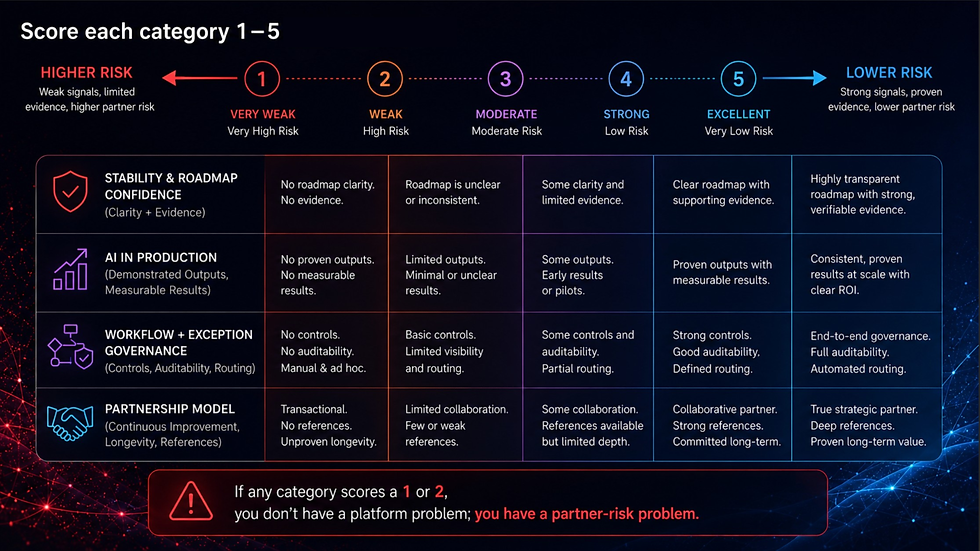
Score each category 1–5 (expand list):
Stability & Roadmap Confidence (Clarity + Evidence)
AI in Production (Demonstrated Outputs, Measurable Results)
Workflow + Exception Governance (Controls, Auditability, Routing)
Partnership Model (Continuous Improvement, Longevity, References)
If any category scores a 1 or 2, you don’t have a platform problem; you have a partner-risk problem.
Conclusion
If you’re re-evaluating your technology stack in 2026, start with the three questions above, then insist on evidence. The best partners will welcome scrutiny because they can show stability, demonstrate AI in production, and point to long-term client outcomes.
FAQs
What’s the Difference Between “AI-Enabled” and “AI in Production”?
“AI-enabled” often means roadmap intent. “AI in production” means the platform is currently using machine learning to process live data and produce measurable operational outcomes (speed, quality, insight).
What Should We Ask to Avoid AI-Washing?
Ask to see AI outputs on real bordereaux, inquire about how exceptions are handled, and ask what parts of the result are auditable/explainable.
Is Switching Platforms Risky?
Any platform switch carries risk, but the highest-risk situation is staying with a partner whose incentives, roadmap, or capability maturity no longer align with your operating reality.



Comments